The Death of Charitable Democracy
Something has gone terribly wrong in the hallowed halls of British charity retail. What was once the last bastion of egalitarian fashion—where pensioners, students, and vintage enthusiasts could browse together in harmonious disorder—has been systematically infiltrated by the kind of people who use 'curated' as a verb and consider themselves 'retail experience architects.'
The transformation began quietly, as most revolutions do. A few strategically placed succulents here, some fairy lights there, and suddenly your local Oxfam looked less like a jumbled treasure trove and more like an Instagram-ready lifestyle destination. But the real shock came when regular customers started receiving emails about 'membership opportunities' and 'exclusive preview events.'
The Algorithm Has Entered the Building
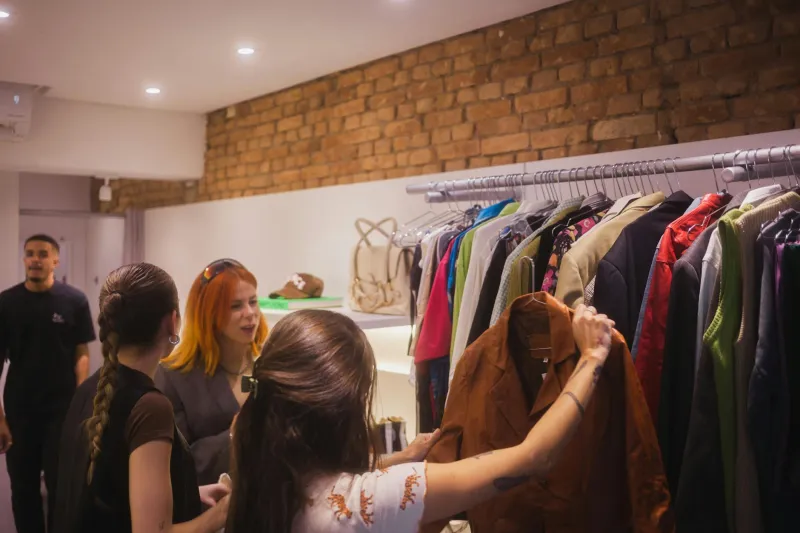
At the epicentre of this seismic shift stands Margaret Pemberton-Hughes, a 67-year-old retired headmistress who has somehow become the gatekeeper of vintage fashion in North London. Armed with a weekend certificate in 'Retail Curation and Customer Journey Optimisation' from a community college in Hertfordshire, Margaret has transformed the Hampstead Age Concern into what can only be described as a charity shop speakeasy.
 Photo: Hampstead Age Concern, via www.ageconcernsandwich.com
'We've implemented a sophisticated inventory management system,' Margaret explains with the pride of someone who's discovered fire. 'Items are now categorised by decade, condition, and what I call 'lifestyle compatibility.' It's about creating a more intentional shopping experience for our discerning clientele.'
The 'sophisticated system' turns out to be a colour-coded spreadsheet and a collection of laminated signs reading 'Vintage Verification Required' and 'Pre-1990 Items: Appointment Only.' Margaret herself serves as both database and bouncer, possessing an uncanny ability to assess a customer's worthiness based on their handbag and general demeanour.
The Membership Hierarchy Explained
The charity shop membership tiers read like a social experiment designed by someone who's never experienced genuine human interaction. At the bottom sits 'Community Friend' (free membership, access to basic rails, no vintage privileges), progressing through 'Sustainable Supporter' (£5 monthly fee, early access to 'curated selections'), and culminating in 'Heritage Patron' (£25 monthly fee, personal shopping appointments with Margaret herself).
Sarah Chen, a 28-year-old teacher who's been shopping at the store for three years, discovered the new system when she attempted to examine a 1980s Jaeger blazer. 'Margaret appeared from nowhere like some sort of retail ninja and informed me that the blazer was 'Heritage Tier only.' When I asked what that meant, she handed me a leaflet about membership benefits and suggested I might be more comfortable browsing the 'contemporary casual' section.'
The contemporary casual section, it transpires, consists mainly of Primark items from 2019 and a selection of promotional t-shirts that Margaret has deemed 'suitable for entry-level vintage enthusiasts.'
The Waiting List Phenomenon
Perhaps most bizarrely, several London charity shops have introduced waiting lists for popular items. The Notting Hill Cancer Research shop now operates what manager Penelope Ashworth-Clarke calls 'a democratic queuing system for high-demand pieces.' Customers can register interest in specific items via a tablet system that looks suspiciously like it was designed for restaurant reservations.
 Photo: Notting Hill Cancer Research, via www.nottingham.ac.uk
'We had seventeen people interested in a vintage Burberry trench coat,' Ashworth-Clarke explains. 'Rather than create unseemly competition, we've developed a fair rotation system based on membership level, previous purchase history, and what we call 'style compatibility assessments.'
The style compatibility assessment, according to leaked internal documents, involves a brief interview about the customer's 'lifestyle goals' and 'fashion philosophy.' One customer reported being rejected for a vintage blazer on the grounds that her current wardrobe was 'too eclectic for heritage tailoring.'
The Pricing Revolution
Gone are the days when charity shop pricing followed the simple logic of 'affordable for everyone.' Today's charity retail operates on what industry insiders call 'market-responsive value positioning'—a fancy way of saying they've discovered Google and eBay.
A vintage Hermès scarf that might once have been priced at £15 now commands £85, complete with a certificate of authenticity signed by Margaret and a small card explaining the 'investment potential of classic accessories.' Even basic items have been subjected to what staff call 'lifestyle pricing'—a Marks & Spencer cardigan becomes £25 when reclassified as 'sustainable knitwear for the conscious consumer.'
'We're not just selling clothes anymore,' explains Cordelia Featherstone, volunteer coordinator at the Chelsea British Heart Foundation. 'We're offering carefully curated lifestyle solutions for the environmentally conscious consumer. Our pricing reflects the true value of sustainable fashion choices.'
The Customer Experience Revolution
The shopping experience itself has been 'optimised' beyond recognition. Many stores now require appointments for vintage browsing, complete with personal stylists who are actually retired teachers with strong opinions about appropriate colour palettes. The Kensington RSPCA shop offers 'wardrobe consultation sessions' where customers can discuss their 'style journey' with a volunteer who's completed an online course in 'Personal Shopping Fundamentals.'
James Morrison, who attempted to buy a simple jumper from his local Save the Children shop, described his experience as 'more invasive than a medical examination.' 'A woman called Fenella insisted on discussing my lifestyle before allowing me to try anything on. She wanted to know about my career goals, my relationship status, and whether I was 'emotionally ready for knitwear commitment.' I just wanted something warm to wear to the pub.'
The Resistance Movement
Not everyone has embraced the charity shop revolution. A underground network of what Margaret calls 'traditional browsers' has emerged, sharing information about which shops still operate on the old system of 'turn up, browse, buy.' These rebels congregate in the remaining unreformed charity shops, where items are still priced according to their actual affordability and volunteers limit themselves to operating the till rather than conducting lifestyle audits.
'There's a Sue Ryder in Peckham that still lets you just walk in and look at things without an appointment,' whispers one resistance member. 'No membership tiers, no style consultations, just clothes on rails like God intended.'
The Future of Charitable Fashion
As the charity shop gentrification continues, industry experts predict even more dramatic changes ahead. Rumours persist of plans for charity shop personal shoppers, subscription boxes curated by volunteers with art history degrees, and even charity shop 'experiences' that include sustainable lifestyle coaching and mindfulness workshops.
Meanwhile, Margaret continues her reign over the Hampstead Age Concern, guardian of vintage treasures and arbiter of style compatibility. When asked about her vision for the future, she speaks with the passion of someone who's found their true calling: 'We're not just preserving clothes, we're preserving the art of conscious consumption. Every purchase should be a journey of self-discovery and environmental responsibility.'
For the rest of us, it seems the simple pleasure of charity shop browsing has been sacrificed on the altar of retail optimisation. In the brave new world of charitable commerce, even buying second-hand requires a membership tier and a lifestyle assessment.
Democracy, it appears, is not for sale—because it's been replaced by a membership scheme.