Welcome to the Circle of Judgment
The Conscious Closet Circle meets on the third Thursday of every month in a Dalston community hall that smells permanently of herbal tea and disappointment. I discovered it through a Facebook event shared by someone whose bio reads 'Slow Fashion Advocate | Plant Parent | Decolonising My Wardrobe One Piece at a Time.' The description promised 'a safe space for sustainable fashion enthusiasts to share experiences, swap items, and support each other's ethical consumption journeys.'
What it actually delivered was ninety minutes of the most competitive virtue signalling I've ever witnessed, punctuated by the kind of passive-aggressive commentary that would make a parish council meeting look like a love-in.
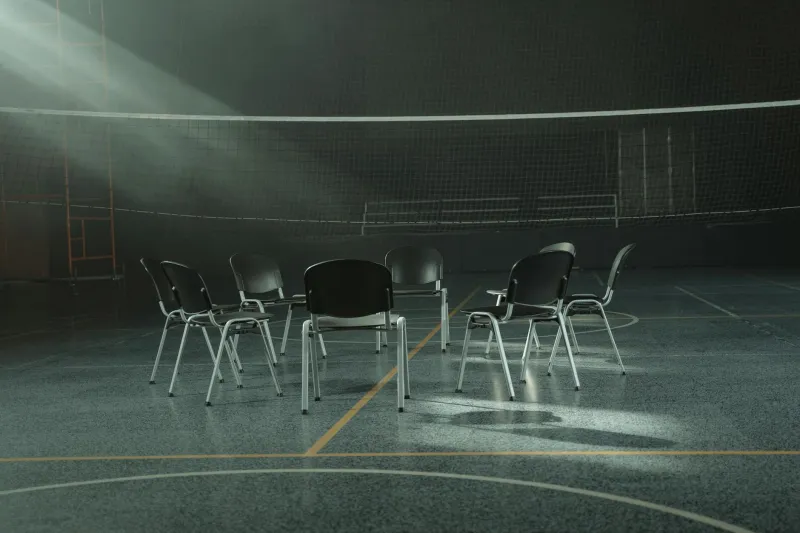
I arrived at 7pm sharp to find twelve women and one brave man arranged in a circle of mismatched chairs, each clutching a reusable cup and wearing the uniform of the ethically enlightened: linen trousers, vintage band t-shirts, and the confident expression of people who have never doubted that their consumer choices could save the world.
The Introductions Round
'Let's start with introductions,' announced the group facilitator, a woman named Sage who operated with the authority of someone who has never owned anything manufactured after 1995. 'Share your name, your sustainable fashion journey, and one item you're struggling to replace ethically.'
What followed was a masterclass in competitive suffering. Emma from Hackney had been 'fast fashion free' for three years and was currently 'wrestling with the ethics of vintage leather.' James from Bermondsey had spent six months researching ethical underwear options and was considering going commando as a form of protest against the industrial textile complex.
Then there was Cordelia – and yes, of course someone was called Cordelia – who announced that she had 'decolonised her entire wardrobe' and now exclusively wore garments made by 'indigenous artisans using traditional methods.' She was struggling to find ethically produced wellington boots, which seemed like a very specific form of middle-class suffering.
The Confession Session
After introductions came what Sage called 'sharing time' – essentially a secular confession booth where members admitted their sustainable fashion sins. The format was familiar: state your transgression, explain the circumstances, receive absolution from the group.
'I bought a jumper from COS last week,' whispered a woman named Fern, as if she were admitting to shoplifting. 'I know it's not technically fast fashion, but I'm worried about the supply chain transparency.'
The group murmured supportively whilst Cordelia made notes in a leather-bound journal (vintage, she assured us when questioned). 'What triggered the purchase?' asked Sage, employing the kind of therapeutic tone usually reserved for addiction counselling.
Fern explained that she'd had a difficult week at work and had 'emotionally shopped' during her lunch break. The group nodded knowingly – they'd all been there, apparently. Someone suggested she try 'mindful browsing' instead, which involved looking at clothes online without purchasing them as a form of meditation.
The Zara Incident
The evening's dramatic peak came when someone – let's call her Lucy – made the catastrophic error of admitting she still owned items from Zara purchased 'in the dark times' (i.e., after 2019, when sustainable fashion consciousness apparently reached critical mass).
The silence was deafening. Twelve pairs of eyes turned to Lucy with the kind of pitying expression usually reserved for the terminally ill. Cordelia actually gasped.
'Have you considered a wardrobe detox?' suggested someone gently, as if Lucy might not have thought of simply throwing away perfectly good clothes in the name of ethical purity.
'I've been meaning to,' Lucy mumbled, clearly regretting her honesty. 'It's just... some of them still fit really well.'
This sparked a twenty-minute discussion about the 'emotional labour' of letting go of problematic garments. Someone suggested a 'cleansing ritual' involving burning sage whilst donating items to charity. Another recommended a 'gratitude practice' where Lucy would thank each Zara piece for its service before releasing it 'back into the universe.'
The Upcycling Olympics
The evening's second half focused on 'sustainable solutions' – a showcase where members displayed their latest upcycling projects with the pride of parents at a school sports day. Cordelia presented a handbag she'd crafted from 'reclaimed denim and ethically sourced hemp,' which looked suspiciously like something a GCSE textiles student might produce after a particularly challenging term.
'The construction took forty-seven hours,' she announced, as if the time investment somehow justified the fact that it looked like a wonky pencil case. 'But that's the beauty of slow fashion – every stitch is intentional.'
Fern had transformed a vintage dress into what she called 'sustainable loungewear' through the simple expedient of cutting it up and sewing it back together in a slightly different configuration. The result was unwearable, but apparently that wasn't the point.
'It's not about the end product,' explained Sage when I unwisely questioned the garment's functionality. 'It's about the journey of conscious creation.'
The Depop Entrepreneur
The evening's most surreal moment came when a woman named Juniper – who had been suspiciously quiet during the confession session – suddenly launched into what could only be described as a sales pitch. She produced a selection of what she called 'upcycled accessories' from a hessian bag, including several bucket hats that appeared to have been constructed from tea towels and regret.
'Each piece is completely unique,' she announced, displaying a hat that looked like it had been assembled by someone wearing oven mitts. 'Eighty-five pounds each, or three for two-hundred.'
The group examined these textile disasters with the reverence usually reserved for religious artifacts. Someone actually bought one. I watched £85 change hands for what was essentially a tea towel with a chin strap and felt my faith in human judgment quietly expire.
The Moral Inventory
As the evening wound down, Sage led us through a 'moral inventory' exercise – essentially a guided meditation on our consumer sins. We were instructed to close our eyes and 'visualise our wardrobes' whilst reflecting on 'the true cost of our choices.'
'Feel the weight of each garment's journey,' Sage intoned, as if our clothes were carrying the spiritual burden of their manufacturing process. 'Acknowledge the hands that made them, the resources that were consumed, the true price of your fashion choices.'
I opened one eye to find half the group genuinely tearful, apparently overwhelmed by the moral complexity of getting dressed. Someone was actually sobbing over a Primark t-shirt they'd owned since 2018.
The Homework Assignment
Before we left, Sage handed out 'sustainable fashion homework' – a series of tasks designed to 'deepen our ethical practice.' These included researching the supply chain of one item in our wardrobes, writing a letter of gratitude to a garment we planned to donate, and spending a week 'shopping our own closets' instead of buying anything new.
There was also a reading list featuring books with titles like 'The Conscious Closet' and 'Fashion Revolution: Why Your Clothes Matter.' I suspected these were the kind of books that made getting dressed feel like a PhD dissertation.
The Walk of Shame
Leaving the community hall, I felt oddly deflated. I'd entered the evening as someone who occasionally bought secondhand clothes and tried to avoid obviously exploitative brands – nothing revolutionary, but a reasonable attempt at conscious consumption.
I left feeling like a moral failure who had somehow missed the memo that every clothing purchase required the kind of ethical gymnastics usually reserved for major life decisions. The group had managed to make sustainable fashion feel less like a positive choice and more like a form of penance.
The Lingering Questions
Walking through Dalston's streets, past the vintage shops and organic cafes that cater to exactly this demographic, I couldn't shake the feeling that I'd witnessed something more troubling than helpful. The Conscious Closet Circle had turned ethical consumption into a competitive sport, complete with its own hierarchy of moral superiority and elaborate rituals of public confession.
Perhaps most perversely, the people who seemed most confident about their sustainable fashion credentials were also the ones spending the most time and mental energy thinking about clothes. They'd created a system where ethical consumption required constant vigilance, endless research, and the kind of moral inventory that would exhaust a medieval monk.
Meanwhile, Juniper was probably at home listing more £85 bucket hats on Depop, having successfully monetised the group's collective guilt about fast fashion.
I never went back to the Conscious Closet Circle. Some forms of consciousness, it turns out, are more exhausting than ignorance.