Wearing Clothes to London Fashion Week Is Now Considered Gauche, Sources Confirm
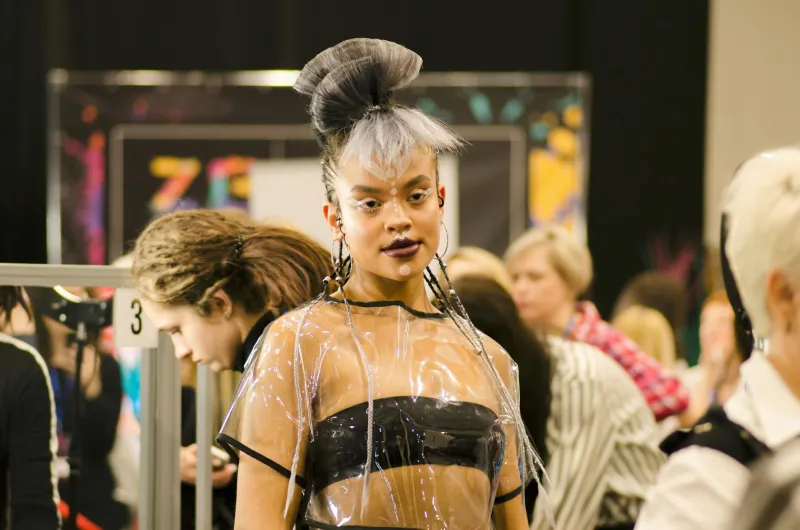
Wearing Clothes to London Fashion Week Is Now Considered Gauche, Sources Confirm
LONDON — In what industry insiders are describing as 'a bold creative pivot' and what everyone else is describing as 'what,' the AW25 London Fashion Week season has quietly produced a consensus that will reshape the industry for at least the next three weeks: the wearing of recognisable clothing is, as of this season, over.
Not unfashionable. Not passé. Over. As in: done. As in: if you walked into the Kristoff Bleurgh presentation at a repurposed cold storage facility in Bermondsey wearing a coat and trousers, you would be asked to leave, and the asking would be done with a very specific expression — not hostile, just profoundly, personally disappointed.
The Movement Has a Name, and the Name Is Terrible
The emerging aesthetic — if 'aesthetic' is still a word that applies when the aesthetic is 'less' — has been christened, by Bleurgh himself, as Intentional Textile Absence, a phrase that manages to be simultaneously pretentious, self-aware about being pretentious, and still entirely sincere.
'The garment has become a crutch,' Bleurgh told a room of journalists who were all writing the phrase 'the garment has become a crutch' in their notebooks with entirely straight faces. 'We have been hiding behind cloth for too long. This season, I am asking: what if we simply... gestured toward cloth? What if the relationship between body and fabric became one of suggestion rather than application?'
His show notes — which ran to eleven pages and were printed on paper that had been lightly distressed to suggest it had lived a full life — described the collection as 'a meditation on the violence of the hem' and 'a reckoning with the colonial legacy of the button.'
The collection itself featured twelve looks, seven of which involved fabric that had been 'strategically withheld' from the areas where fabric would typically be present, and one of which was a model standing very still next to a chair on which a jacket had been placed but not worn.
'That's the most important look,' a publicist explained, gesturing at the empty jacket with the gravity of someone describing a Turner Prize shortlist. 'The jacket being there, but not being worn — that's the conversation.'
We asked what conversation. She looked at us as though we had arrived wearing trousers, which we had.
Conceptual Fabric Adjacency: A Glossary
For those not yet fluent in this season's critical vocabulary, our correspondent has compiled the following essential terms, extracted from show notes, post-show interviews, and one very intense conversation overheard in the queue for a £14 oat flat white in Shoreditch.
Intentional Textile Absence (ITA): The deliberate non-application of fabric to areas of the body where fabric might conventionally appear. Not nudity. Nudity is too literal. ITA is about choosing not to be covered in a way that makes the choice visible. Distinguished from simply forgetting your jumper by the quality of the decision.
Conceptual Fabric Adjacency (CFA): Wearing something near clothing without technically wearing the clothing. A coat held in one hand. A trouser draped over a shoulder. A blouse existing in the same room as your body but not on it. The relationship between wearer and garment is 'dialogic' rather than 'functional,' which is another way of saying cold.
Textile Memory: The trace left by clothing that has been removed. A crease. A slight warmth. The ghost of a collar. Several designers this season have shown 'Textile Memory Pieces,' which are, functionally, nothing, but presented with such conviction that at least four journalists described them as 'hauntingly beautiful.'
Bourgeois Covering: The act of wearing clothing in a way that provides warmth, protection, or modesty. Considered, in the context of AW25, a failure of imagination.
Other Designers Weigh In
Bleurgh is not alone in his convictions. Across the week, a loose coalition of designers appeared to have arrived, independently, at the same conclusion: that clothes — as objects worn on bodies — represent a creative dead end.
Miranda Voss-Kleist, whose presentation at a former public toilet in Dalston drew both a waiting list and a noise complaint, showed a collection she described as 'post-garment wearables.' The pieces, when worn, were entirely invisible to the naked eye. This was not a manufacturing error. It was, Voss-Kleist explained in her show notes, 'a direct challenge to the hegemony of visibility.'
'The most radical thing a designer can do in 2025,' she wrote, 'is refuse to be seen. The clothes are there. You simply cannot see them. That is the work.'
Three buyers placed orders. None of them asked follow-up questions.
Meanwhile, the collective known as HAUS HAUS HAUS presented a show in which every garment was made entirely from the concept of a previous garment. A jacket that was, technically, a memory of a jacket. Trousers that existed 'in reference' rather than in fabric. A coat that had been 'emotionally constructed' but not physically realised.
The show notes ran to twenty-two pages. The show lasted four minutes. A journalist from a major glossy described it as 'the most important four minutes of the decade.' She has since been promoted.
The Journalists Who Cover This, God Love Them
It would be easy — and we want to be clear that we are going to do it anyway — to focus attention on the fashion press, who have spent the past week earnestly reporting on these developments with the kind of solemn professionalism usually reserved for geopolitical crises.
One broadsheet fashion desk ran a 2,000-word feature headlined: 'Is the End of the Garment Actually the Beginning of Something?' The answer, across 2,000 words, was: possibly. Another publication ran a photo essay titled 'The Body Unchained: How AW25 Is Dismantling the Architecture of the Dressed Self,' which featured fourteen photographs of people standing in rooms wearing very little and looking at middle distance.
We reached out to several fashion editors for comment. Most did not respond. One replied with a single sentence: 'You're not ready for this conversation.' We are, genuinely, not sure she is wrong.
What This Means for the Rest of Us
For those not attending London Fashion Week — which is to say, most people, including people who are perfectly fine with their coats — the practical implications of the ITA movement are, for now, limited.
You may continue wearing clothes. Your trousers remain, legally and socially, acceptable. Your hem is not, as far as anyone can confirm, a form of violence.
But be warned: if the history of fashion tells us anything, it is that whatever happens in a repurposed cold storage facility in Bermondsey in February will, in some diluted and barely recognisable form, appear in a Zara look book by September.
The heritage relaxation trouser, it turns out, may be the last line of defence.
Wear it while you can.