Dunelm Has Started Selling Clothes and Britain's Middle-Market Women Are Being Forced to Pick a Lane
Dunelm Has Started Selling Clothes and Britain's Middle-Market Women Are Being Forced to Pick a Lane
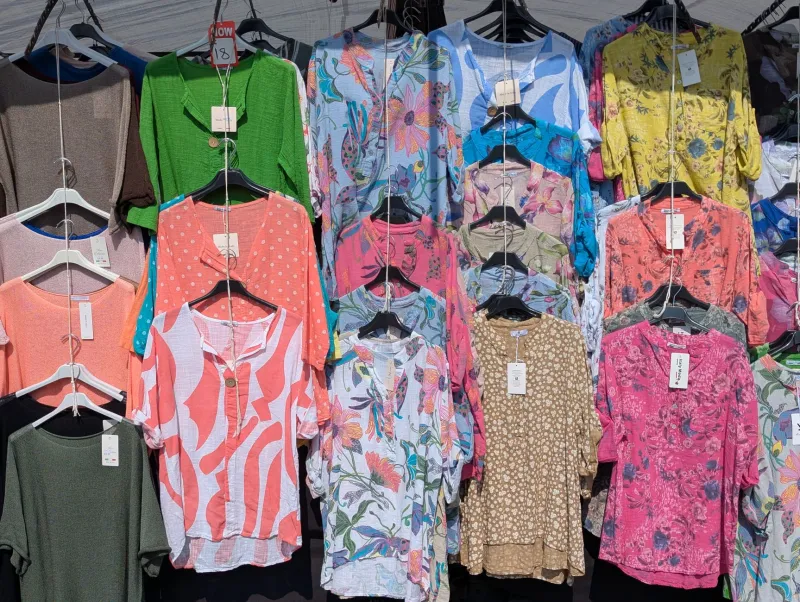
There are moments in history that demand a reckoning. The fall of Rome. The dissolution of the monasteries. The discontinuation of the Boden needlecord pinafore in 2019. And now, quietly, without fanfare or a single press release landing in a fashion editor's inbox, Dunelm — the Midlands-born homeware behemoth most famous for its roman blinds and its inexplicably soothing car parks — has started selling women's clothing.
Britain has not been this unsettled since John Lewis introduced a food hall.
'I Was Just There for a Scatter Cushion'
Fiona, 43, from Solihull, discovered the clothing range on a Tuesday morning in late spring. She had gone in for a replacement duvet insert and perhaps, if she was being honest with herself, a browse of the seasonal throws. She did not expect to emerge forty-five minutes later clutching a broderie anglaise blouse in sage green and a pair of wide-leg linen trousers that she describes, with some bewilderment, as 'genuinely nice.'
'I've been processing it ever since,' Fiona tells us, seated in a kitchen that features no fewer than three Dunelm accessories, including a ceramic utensil pot she has named Gerald. 'Like, I love Dunelm. I trust Dunelm. Dunelm has never let me down with a blackout lining. But clothing is different, isn't it? Clothing is personal.'
It is, Fiona. It is.
The existential difficulty here is not merely aesthetic. It is structural. Britain's middle-market fashion hierarchy — that delicate, unspoken lattice of brand loyalty that separates the Joules gilet woman from the White Stuff tunic woman from the Fat Face fleece woman — has been built over decades. Everyone knows where they stand. Everyone knows what their Cath Kidston tote communicates about their relationship to the National Trust and their opinion on grammar schools. The system, fragile as it is, functions.
Dunelm selling broderie anglaise blouses is a Category Five disruption event.
The Joules Gilet Women Are Watching Very Carefully
We reached out to several women who self-identify primarily through their outerwear.
Sarah, 47, a Joules loyalist from Cheshire who describes her aesthetic as 'country-adjacent but technically suburban,' says she is 'reserving judgement' on the Dunelm clothing range. 'I mean, I think it's lovely that they're trying,' she says, in the tone of someone who does not think it is lovely. 'But Joules has a heritage. There's a story there. Dunelm's story is that they once sold me a set of blackout curtains that genuinely changed my marriage.'
This is not an unusual response. Across Britain's commuter belt, women who have spent considerable energy curating what might loosely be called a 'lifestyle brand identity' are now confronting an uncomfortable question: if the place you buy your bath mats also sells your blouses, what does that mean for the narrative you've constructed around your personal style?
Vivienne, 51, from Knutsford, puts it more plainly: 'It's like if Waitrose started doing haircuts. Technically fine. Possibly even good. But something would be lost.'
The Aspirational Ambiguity Problem
What makes Dunelm's fashion foray particularly destabilising is that the clothes are not, by any objective measure, bad. Industry observers note that the range sits comfortably in the same territory as Per Una, Fatface, and the less adventurous end of the M&S summer edit — which is to say, it is exactly what a large proportion of British women aged 38 to 58 actually want to wear.
And therein lies the crisis.
The middle-market British woman has long depended on a certain amount of brand friction to justify her spending. You pay a bit more at Joules because Joules is Joules. You accept the slightly aggressive pricing at Boden because Boden is a whole worldview. But Dunelm, beloved and democratic Dunelm, with its loyalty points and its free car parking and its café that does a perfectly acceptable cappuccino, does not traffic in aspiration. It traffics in comfort and reasonable value. Which is, frankly, what everyone actually wants, and the fashion industry has spent forty years pretending otherwise.
By making good, sensible, wearable clothes at non-punishing prices, Dunelm has essentially called the bluff of every mid-market brand that has been charging a 40% premium for the privilege of a logo on a canvas bag.
The Homeware-to-Wardrobe Pipeline Is Now Real
There is, of course, a deeply British precedent for this kind of retail category creep. Laura Ashley built an empire on the premise that the same woman who wanted floral wallpaper also wanted to wear floral wallpaper. M&S has always understood that its customer shops for school shoes, Percy Pigs, and a reliable shift dress in the same forty-five minute window. The boundaries between home and self have always been porous in British retail.
But Dunelm feels different. Dunelm is specifically about the home. It is about nesting and cocooning and expressing your inner life through the medium of a textured cushion cover. The idea that this same impulse now extends to what you put on your body raises questions that Britain's wellness industry will be monetising within the month.
Already, sources close to the Cotswolds retreat circuit report that several 'lifestyle alignment coaches' are preparing workshops on what they're calling 'domestic identity bleed' — the phenomenon whereby a woman's home aesthetic and personal style become so thoroughly merged that she cannot, in good conscience, leave the house in anything that doesn't match her living room palette.
Fiona, back in Solihull, has already worn the sage blouse twice. She wore it to a school governors' meeting and received three compliments. She did not tell anyone where it was from.
'Not yet,' she says. 'I'm not ready for that conversation yet.'
Neither, Fiona, is Britain.